The Hidden Problem With Old-Style Dressings: They Absorb Blood but Don’t Stop Bleeding
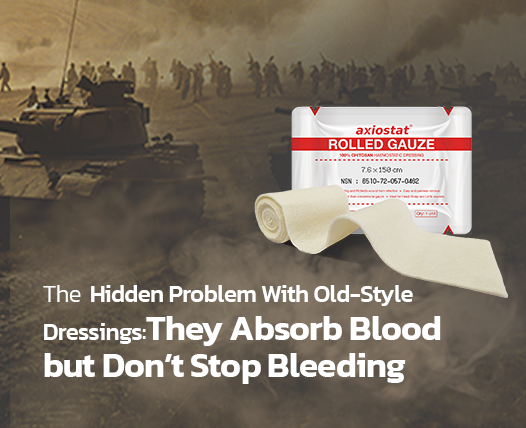
The Hidden Problem With Old‑Style Dressings
Typically, gauze is used as the first line of defence in emergency situations whether it be in a war zone, at a place where an accident has occurred, or even if you are out enjoying nature. For many years, traditional types of gauze have been used. That is how most people are trained to use and many first aid kits still contain them. However, the reality is that traditional dressing types do little to help with blood loss and the clotting process. They typically just act as a temporary stopgap
When traditional dressings are saturated, they need to be removed and replaced at which point they can dislodge a recently formed clot, thereby delaying the healing process, can lead to re-bleeding, and creating a greater opportunity for infection due to multiple exposures to the original wound. In these high-pressure environments, the added time lost to ineffective dressing methods can lead to fatalities.
Why Traditional Gauze Falls Short
Gauze is a non-compressive (clothing / textile) product with the purpose of soaking wet and putting a compressive force onto a wound to prevent blood loss. Gauze itself does not promote coagulation (stopping the flow of blood from an open wound). Therefore, gauze relies completely on the factors of time, pressure and the life-sustaining function of an injured man. This is generally sufficient for a small, minor wound, but in the case of large, deep, and/or severely bleeding wounds or for trauma that occurs in places where there are no medical facilities available, plain gauze provides inadequate protection.
The greatest danger of using gauze to stop bleeding from a wound comes when the gauze has to be replaced. After the gauze is replaced, it is common for bleeding to reoccur due to the fact that cotton-based products do not adhere to cells in the bloodstream, nor do they aid in the coagulation process. This is a common occurrence within military and combat medicine, as even a slight break in the pressure on a wound can result in the re-opening of that same wound.
Studies show that uncontrolled hemorrhaging is one of the top 5 causes of preventable deaths during combat. The reason is that there isn't sufficient gauze the issue is that gauze does not assist the body in stopping the source of the bleeding.
Introduction to Hemostatic Dressings
Hemostatic Gauge Bandages act as a therapeutic dressing for controlling bleeding. Hemostatic dressings are more than a simple absorbent material, they are active components of wound management.
The way hemostatic dressings help to control bleeding is by facilitating or activating the body's natural blood clotting response, through interaction with blood elements such as Red Blood Cells (RBC) & platelets which together create both a physical barrier and a chemical barrier that promote act as stabilizers for the wound.
Often made of advanced materials, Chitosan gauze has been shown to be one of the most effective hemostatic dressings. Due to their effectiveness, they are now part of standard issue for military first aid kits, Emergency Medical Services (EMS) and increasingly in Civilian Traumas.
Chitosan Gauze - Nature’s Fast Clotting Agent
Chitosan is a type of biopolymer that occurs naturally: it originates from the exoskeletons of arthropods such as shrimps, crabs, etc. Chitosan has a negative charge which allows it to draw together the red blood cells that are responsible for clot formation when they are applied topically to an open wound.
When applied to the wound site, chitosan forms a solid bond with the blood and forms a tightly bound structure, therefore allowing the user to better manage how much blood flows from an injury. This allows for faster formation of a clot and decreases the possibility of further bleeding in the event of the dressing being manipulated or removed.
Some of the advantages of chitosan are as follows:
Promotes rapid and natural formation of a tetrahedral shaped clot
Reduces the chance of a clot being dislodged
It is safe and compatible with the body (very little risk of allergic reactions)
Works effectively on multiple types of trauma.
Where is chitosan used?
Battlefield
Emergency Department
Disaster Response
Portable kits for personal trauma and first responders.
Chitosan is rapidly becoming a first choice for reliable control of bleeding in unpredictable environments.
How a Combat Bleeding Control Emergency Kit Changes the Game
The Combat Bleeding Control Kit (CBC) is for use in emergencies where bleeding has to be controlled as rapidly and effectively as possible, and with as little medical equipment as required.
Items included in the Combat Bleeding Control Emergency Kit:
- Hemostatic gauze bandage (usually made with chitosan)
- Compression bandages or wraps
- Gloves, trauma shears, and instructions
- Storage case: compact and sturdy
The combat bleeding kits are for self-administration or assistance, making them ideal for people in a variety of situations including soldiers, emergency medical technicians, hikers, workers in industry, and personnel responding to disasters.
Steps for using the Combat Bleeding Control Emergency Kit:
1. Open the kit and put on gloves to protect yourself.
2. Remove clothing and other debris from the wound if you can see it.
3. Insert the hemostatic gauze into the wound and apply firm pressure.
4. Maintain firm pressure for 1 to 2 minutes while your body forms a clot.
5. Use the compression bandage to wrap or secure hemostatic gauze.
6. Obtain urgent medical care or transport the person injured to the nearest hospital.
In emergencies that may be chaotic, the Combat Bleeding Control Kit can make a life-threatening injury into a survivable injury, especially when advanced medical care may take minutes or longer to arrive.
Common Mistakes With Traditional Dressings
Conventional methods of treatment are often insufficient even with the best of intentions. Here are common errors associated with classic dressings:
Too Soon: The timeframe for applying a dressing while bleeding is critical. Dressing too early interrupts the clot formation process, which can lead to further bleeding.
Insufficient Pressure: Gauze, although necessary, will have little effect if there is not a firm and consistent pressure applied with the dressing.
Using Gauze on Major Wounds: Cotton gauzes are not an adequate dressing for deep or arterial wounds.
No Preparation: Experienced responders can be severely limited in their ability to respond if they do not have access to advanced technologies such as hemostatic gauze bandage materials.
These types of mistakes are very easily avoided by utilizing modern, advanced trauma kits equipped with chitosan-based dressing products.
Conclusion
Despite their ability to soak up blood, Traditional Gauze dressings aren't able to provide any real support or speed up the clotting process as they are merely a band-aid until the time that you get proper care. So by continuing to use these, we are putting the lives of those that have been injured at risk during traumatic, catastrophic or wartime events.
Chitosan-based and Hemostatic dressings provide significant improvements over Traditional Gauze & Dressings as they not only quickly stop bleeding but also allow the body to heal by allowing blood to flow back into the body.
Having a Combat Bleeding Control emergency kit available at home, at work, or in the vehicle, provides a significant advantage in case of emergency. Those who take time to learn how to use the right tools properly will always have the upper hand in the face of a life-threatening situation and will give themselves the best chance of surviving.
Upgrade your Emergency Kit with Chitosan-based Axiostat Gauze Today! For combat-effective bleeding control solutions, contact us or visit our website.



 A collaborative study with Harvard