Hemostatic Gauze: The Overlooked Essential for First Responders and Emergency Rooms
Introduction
One of the biggest avoidable causes of trauma-related mortality in the globe is still uncontrolled bleeding. If bleeding is not stopped right away, large blood vessel injuries, deep cuts, or blunt force trauma can result in fast blood loss, shock, and death. Emergency department staff, paramedics, and first responders frequently have seconds to act. rtality rises with each minute without efficient bleeding control.
There are limitations to standard therapy, particularly for deep or irregular wounds. This includes using plain gauze plus pressure and, if necessary, a tourniquet. A crucial item that is all too frequently disregarded is hemostatic gauze, which is intended to stabilize bleeding and hasten the development of clots. It could be the difference between irreversible harm and death. First responders and emergency room personnel may take decisive action under pressure with the help of a well-equipped Bleeding Control Kit that contains premium hemostatic gauze, increasing results and lowering mortality.
What Is Hemostatic Gauze and Why Does It Matter?
Hemostatic gauze is a specially made bandage that stops bleeding faster than regular gauze. Hemostatic gauze has active ingredients (such chitosan, kaolin, or others) that interact with blood components to speed up clotting, in contrast to ordinary gauze, which absorbs blood and depends on outside pressure.
These dressings prevent blood loss, decrease the need for frequent dressing changes, decrease the time to hemostasis (halt of bleeding), and decrease the likelihood of rebleeding. All of this is crucial in pre-hospital (accident scene, ambulance) and emergency room (ER) settings where time and control are limited.
Composition & Types
Chitosan vs. Kaolin:
Naturally occurring from shellfish shells, chitosan is a positively charged polymer that aids in the development of clots by drawing negatively charged platelets and blood cells. Additionally, chitosan has a lower chance of particle shedding and is generally more biocompatible.
Certain processes in the clotting cascade are activated by the clay mineral kaolin. Several well-known products (such kaolin-impregnated gauze) have employed it. Even while they work well, some kaolin dressings can cause particle shedding or be less kind to some wounds.
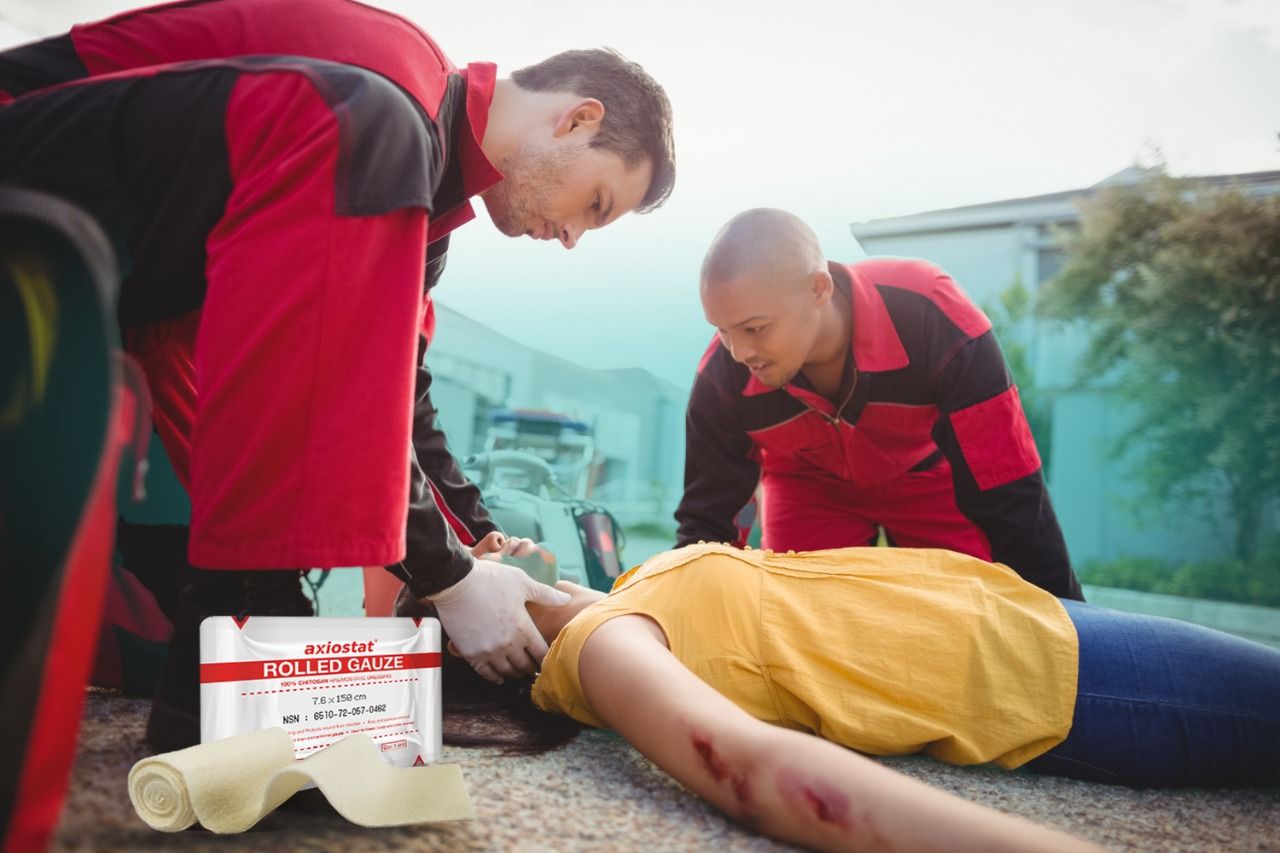
Formats: Z-fold, rolled, patches: • Z-fold gauze is folded in a Z shape; good for packing deep, high-bleeding wounds (e.g., blast injuries, deep lacerations). • Rolled gauze works well for wrapping or bandaging long incisions or limbs. • Patches are useful for smaller, shallow wounds, or when quick application without deep packing is needed.
Selection of the format depends on the wound type, location, amount of bleeding, and access conditions.
How It Differs from Standard Gauze
Active Hemostasis vs. Pressure Only: Standard gauze needs external pressure to compress vessels and rely on the body’s natural clotting, which may be slow or compromised (e.g. in cold, hypothermia, anticoagulated patients). Hemostatic gauze adds a chemical/physical agent to accelerate clot formation, reduce bleeding time, and stabilize clot even when conditions are suboptimal.
Reduced Re-bleeding & Blood Loss: Hemostatic gauze is less likely to allow re-bleeding upon removal or movement, since the clot is more stable. Also, less total blood loss tends to reduce shock, transfusion requirements, and improves chances of survival.
Better in difficult situations: Deep or irregular wounds, coagulopathy (e.g., patients on blood thinners), or when manual pressure isn’t possible for long periods. In those scenarios, standard gauze often fails or becomes impractical.
Where It Fits in the Care Pathway
Prehospital (ABC/TCCC Alignment)
First responders follow basic steps (Airway, Breathing, Circulation). When circulation is compromised by external bleeding, hemostatic gauze becomes a tool in the “C” (circulation) arm.
Use after the scene is safe.
Pack wound with hemostatic gauze if direct pressure alone is insufficient.
Apply sustained pressure for a defined minimum interval (commonly 3-5 minutes) while waiting for help or transporting.
Use a tourniquet when appropriate (for limb bleeding that can’t be controlled by packing or pressure). Reassess regularly.
These align with TCCC (Tactical Combat Casualty Care) or civilian equivalents: rapid control of hemorrhage is often the highest priority pre-hospital.
Emergency Room (Handoff to Removal/Irrigation)
After patient reaches the ER:
Document how wound was controlled, what dressings used, and time to hemostasis.
If imaging is needed (e.g., vascular injury), preserve that info.
Removal: irrigate hemostatic gauze (often saline or sterile water) before gentle removal to avoid disrupting the clot.
Monitor for re-bleeding, signs of infection, or necrosis.
Escalate if bleeding persists (e.g. surgical intervention), or if the dressing cannot be removed cleanly.
First Responder Application (Step-by-Step)
Here’s a practical sequence for using hemostatic gauze effectively:
Ensure scene safety; don gloves and personal protective equipment.
Identify the source of bleeding; remove large contaminants.
Select appropriate gauze format (patch for small, z-fold or rolled for deep wounds).
Pack the wound deeply until the gauze contacts bleeding surfaces.
Apply firm, direct pressure over the packed gauze, at least 3-5 minutes without interruption.
Use a secondary dressing or bandage to secure the gauze and maintain pressure.
Monitor the wound site; reassess after pressure period; if bleeding persists, could require repacking or escalation.
ER Best Practices
On arrival, assess prior dressing and time since application. Confirm hemostasis.
Use aseptic technique when removing or replacing dressing. Irrigate thoroughly.
Check the patient's coagulation status (drugs, disorders). Adjust management if the patient is anticoagulated.
Use defined criteria to decide when to remove the gauze (e.g., when bleeding has stopped for some time, dressing is saturated etc.).
Document all care, times, observations; supports quality assurance and legal/clinical follow-ups.
Building a Bleeding Control Kit
To ensure hemostatic gauze is available when needed, kits should be well prepared:
Essentials: Hemostatic gauze (in multiple formats if possible), gloves, antiseptic wipes, secondary dressings, bandages, scissors, personal protective items.
Shelf life / Stock Rotation: Hemostatic dressings like chitosan-based products often have long shelf lives (e.g. Axiostat Z-fold has 5 years) - check and rotate stocks to avoid expiry. Axiostat Trauma -
Sizes & Quantities: Enough to handle the population and likely trauma severity; kits for ambulances, first responder vehicles, ERs, military medics.
Procurement & Protocol Integration
Identify NSN/ordering pathways (or equivalent procurement identifiers) to ensure standardized supply chains.
Establish stocking levels based on expected use rates, risk areas (battlefield, rural, disaster zones).
Update Standard Operating Procedures (SOPs) to include hemostatic gauze as a first-line item, specifying when and how to use it.
Training, Drills & Quality Assurance
Conduct regular training for first responders and ER staff on hemostatic gauze: packing technique, pressure application, removal. Hands-on drills improve confidence and efficacy.
Common errors: insufficient packing depth, removing pressure too soon, not securing dressing.
Refresh intervals (e.g., annually) to reinforce skills, especially for less frequent users.
FAQs
Tourniquet vs. Hemostatic Gauze – when to use each? Use a tourniquet for limb hemorrhage that cannot be controlled by gauze and pressure alone. Hemostatic gauze is often used for wounds that are difficult to tourniquet (torso, junctional areas), or as adjuncts.
How long to apply pressure? Usually 3-5 minutes continuous pressure is recommended; if bleeding persists, repack or escalate.
Are there contraindications? Yes, known allergy to active agents (e.g. shellfish for chitosan), internal bleeding, or wounds contaminated heavily might need surgical cleaning first.
Will it leave residue or damage tissue? Good quality hemostatic gauze (e.g. chitosan based) is designed to be removed cleanly, often after irrigation, with minimal trauma to the clot or tissue.
What about the environment / temperature? Many modern dressings are tested for harsh environments. For example, Axiostat’s Z-Fold Gauze is designed with a 5-year shelf life and is usable in field conditions.
Real-World Outcomes
Real-World Outcomes: Axiostat in Military and Field Settings
In high-pressure military and field scenarios, controlling bleeding quickly is critical. Real-world case studies highlight how Axiostat performs effectively in such situations.
Case 1: Traumatic Leg Wound During field training, a soldier sustained a deep leg laceration. Immediate application of Axiostat controlled bleeding rapidly, allowing medics to stabilize the patient without delay. The dressing minimized pain, reduced dressing change frequency, and supported faster recovery demonstrating its effectiveness in urgent, real-world conditions.
Case 2: High-Risk Post-Surgical Bleeding A soldier on anticoagulant therapy developed post-surgical wound bleeding. Axiostat provided reliable hemostasis, minimized discomfort, and facilitated steady healing. This case underscores the product’s value in high-risk scenarios where rapid and effective clotting is essential.
These cases show that Axiostat not only works in controlled clinical environments but also delivers practical, life-saving outcomes in real-world military applications, making it a trusted choice for medics and first responders.
Conclusion & CTA
Hemostatic gauze is not just another item in the bleeding control kit - it is an essential, potentially life-saving tool for first responders and ERs. By outperforming standard gauze in speed, blood loss reduction, ease of use, and safety, it fills a critical gap in trauma care and emergency response protocols.
If you manage or sub-manage first responder units, emergency rooms, or procurement, now is the time to integrate high-quality hemostatic gauze into your kits, protocols, and training programs. Download our Bleeding Control Kit Checklist, schedule a training/in-service session, and contact procurement to ensure your institution is ready when every second counts.



 A collaborative study with Harvard